
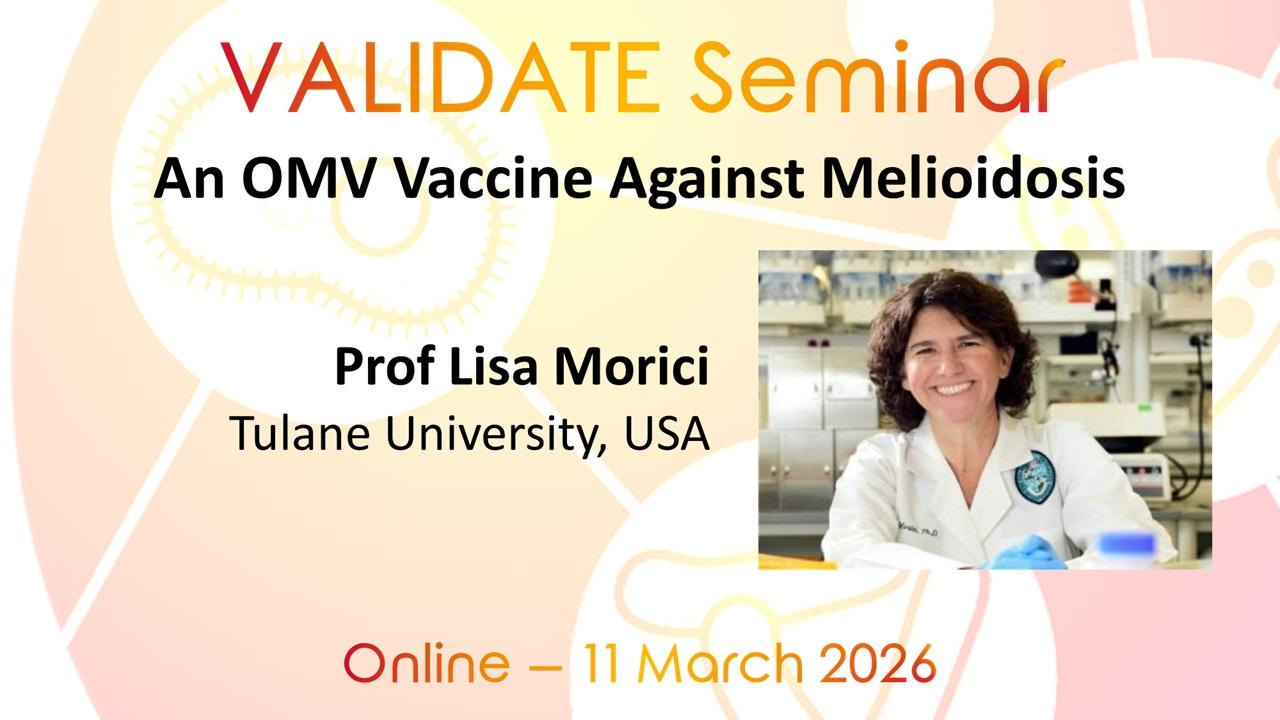
An OMV Vaccine Against Melioidosis
Watch now on the VALIDATE Hub.
About the talk
Melioidosis is an emerging infectious disease caused by the intracellular bacterial pathogen, Burkholderia pseudomallei. Infection of humans and animals can occur through multiple routes of bacterial entry resulting in life-threatening pneumonia and/or bacteremia. Development of an effective vaccine against B. pseudomallei could protect at-risk individuals, such as those who reside in highly endemic areas, military personnel, diabetics, and travelers. Despite decades of pursuit, no candidate vaccine for melioidosis has advanced beyond pre-clinical testing in animal models. We have demonstrated that an outer membrane vesicle (OMV) vaccine is highly protective against inhalational melioidosis in non-human primates based on survivability, biotelemetry, and pathology assessments. Using two independent serologic assays, we demonstrate that vaccine protection in rhesus macaques is associated with systemic and mucosal IgG and IgA to OMV surface proteins and polysaccharides. We show that sera antibody responses to OMV antigens promote opsonophagocytosis and are also associated with survival in human melioidosis patients. In addition to humoral immunity, the OMV vaccine drives antigen-specific human CD4 and CD8 T cells. Collectively, these results attest to the protective efficacy of the OMV vaccine and lay the groundwork for its advancement to human phase 1 clinical trials.
About the Speaker

Dr Lisa Morici is a tenured Professor in the Dept. of Microbiology and Immunology at Tulane University School of Medicine. Her research program focuses on the development of next generation vaccines for emerging and re-emerging infectious diseases. Dr. Morici has pioneered the development of an outer membrane vesicle (OMV) vaccine to prevent infection with Burkholderia pseudomallei and B. mallei. Dr. Morici has also co-developed an OMV based adjuvant called T-vant, that can be used with any type of vaccine immunogen and administered by various routes (oral, IN, IM, etc) to protect against microbial diseases.