
VALIDATE Vaccines for Skin NTDs Seminars - Pathogenesis Seminar 2
About the Seminar
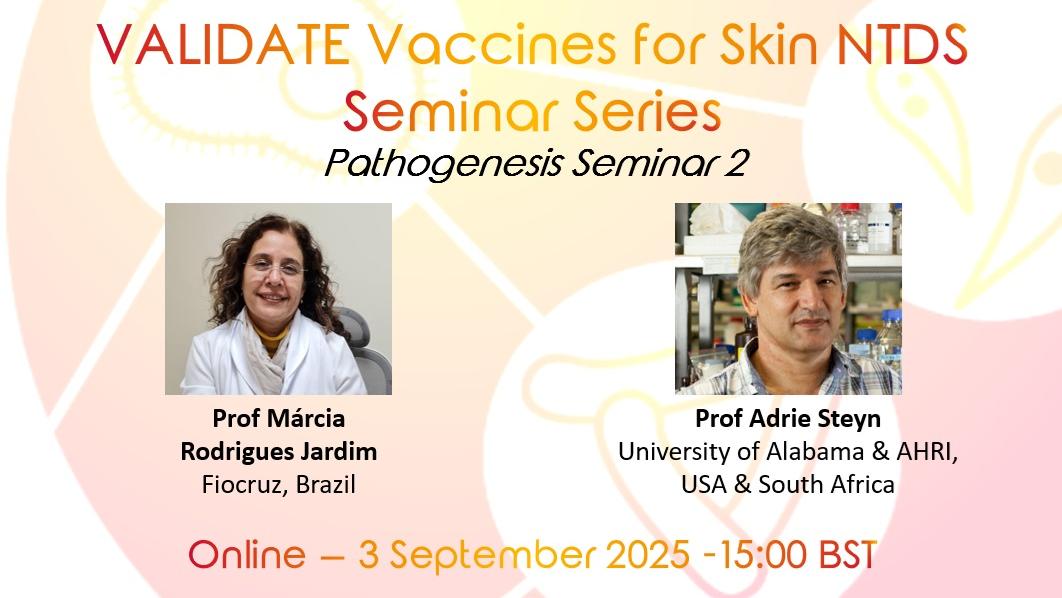
The second seminar in the Skin NTD Seminar Series focused on the pathogenesis of skin neglected tropical diseases (NTDs), featuring expert insights into two major challenges: tuberculosis and leprosy. This was the second and final seminar dedicated to Skin NTD pathogenesis, although the wider Skin NTD Seminar Series continued into late 2025 and 2026.
Unmasking Human Tuberculosis: Insights into Granuloma Biology and Disease Pathogenesis
Prof Adrie Steyn, AHRI and the University of Alabama, South Africa and USA
Despite decades of research, Mycobacterium tuberculosis (M. tuberculosis) remains a formidable pathogen. Central to its persistence and pathogenesis is the diverse spectrum of TB lesions, which remains incompletely understood. In this talk, Prof Steyn presented insights from the systematic study of human TB lesions obtained from surgically resected and postmortem lung tissue. Using spatial transcriptomics, high-resolution mass spectrometry and multiplexed imaging, he described the cellular architecture and molecular gradients that shape the fate of TB lesions. These insights could help accelerate the development of diagnostics, therapies and vaccines that are better attuned to the biology of TB in humans.
Leprosy: History, Pathogenesis and Treatment
Dr Márcia Rodrigues Jardim, Fiocruz, Brazil
Leprosy primarily affects the skin and peripheral nerves, with leprosy neuropathy being its most serious and potentially disabling manifestation. Dr Jardim provided an overview of the disease, highlighted recent scientific advances in understanding its pathogenesis, and explored the crucial role of early diagnosis and treatment.
About the Speakers
Prof Adrie JC Steyn PhD, AHRI & University of Alabama, South Africa & USA
Adrie was appointed at AHRI in Durban, South Africa, and the University of Alabama at Birmingham in Birmingham AL, USA. He is interested in the bioenergetics of Mtb, mode of action of anti-TB drugs targeting the Mtb electron transport chain, and the immunometabolism of Mtb infected host cells. He also studies the spectrum of active TB lesions using a range of next-generation technologies i.e., spatial transcriptomics, multiplex immunofluorescence, metallomics, high-resolution proteomics, 3D structures of granulomas and leads efforts to identify latent TB infected lesions in the lungs of decedents who died of causes other than TB.
Prof Márcia Rodrigues Jardim, Oswaldo Cruz Institute (Fiocruz), Brazil
Prof Jardim is Professor of Neurology and a clinician at the Leprosy Laboratory of the Oswaldo Cruz Institute. Her research focuses on the neurological impacts of leprosy, especially leprosy neuropathy, and improving strategies for early diagnosis and intervention.