Innovative Diagnosis for PKDL/Leprosy Project
VALIDATE Special Project - November 2022 to May 2026
This work was funded by the Gates Foundation (INV-048694)
Led by:
Prof Mitali Chatterjee; VALIDATE Investigator; Institute of Post-Graduate Medical Education and Research (IPGMER), India
Co-Investigators:
Dr Ahmed Abd El Wahed; VALIDATE Investigator; Leipzig University, Germany
Dr Dinesh Mondal; VALIDATE Investigator; International Centre for Diarrhoeal Disease Research, Bangladesh (icddr,b), Bangladesh
Dr Krishna Pandey; Rajendra Memorial Research Institute of Medical Sciences (RMRIMS), India
Dr Nilay K Das; College of Medicine & Sagore Dutta Hospital (CMSDH), India
Coordinators:
Ms Samantha Vermaak; VALIDATE Network Manager; University of Oxford, UK
Mr Tom Wright; VALIDATE Project Manager; University of Oxford, UK
With:
Prof Helen McShane; VALIDATE Network Director; University of Oxford, UK
Prof Samantha Sampson; VALIDATE Network Co-Director; Stellenbosch University, South Africa
Project Aim
In 2022, VALIDATE launched the "Innovative Diagnosis for PKDL/Leprosy" project, spearheaded by Prof Mitali Chatterjee. Focused on combating post-kala-azar dermal leishmaniasis (PKDL) in South-East Asia, the team aimed to create a field-friendly diagnostic tool using a validated isothermal amplification-based assay. Given the clinical overlap between PKDL and leprosy, the project also included a combined diagnostic test. The objective was to deliver a cost-effective, point-of-care tool for monitoring and treating these neglected tropical diseases, aligning with the Kala Azar Elimination Programme and WHO Global Leprosy Strategy.
Project Outcomes
A prospective multicentric Phase III study was conducted at three kala-azar referral centres (i) Institute of Postgraduate Medical Education and Research (IPGME&R), Kolkata, India, (ii) Rajendra Memorial Research Institute of Medical Sciences (RMRIMS), Patna, India, and (iii) Surya Kanta Kala-azar Research Centre (SKKRC), Mymensingh Medical College Hospital, in collaboration with icddr,b
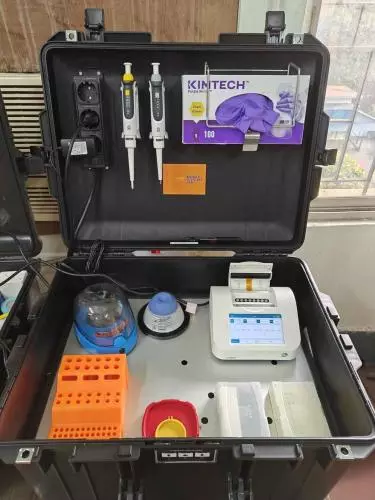
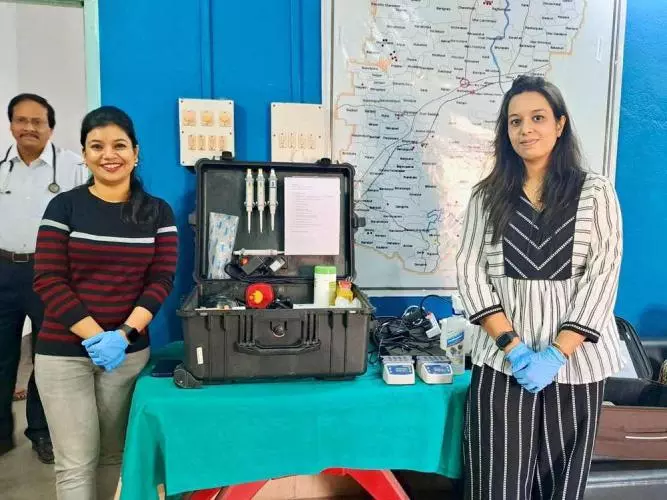
PKDL cases were evaluated by quantitative PCR (qPCR) and Recombinase-Aided Amplification (RAA). Overall, the RAA assay demonstrated high agreement with qPCR across all participating centres. RAA amplification profiles generated in a mobile suitcase laboratory closely paralleled clinical response, with rapid amplification observed at disease presentation and absence of amplification during post-treatment follow-up, consistent with declining parasite load and clinical improvement.
Mycobacterium leprae specific RLEP and 16S gene targeted real-time qPCR was undertaken using specific primers and probes. Initially, several standardization attempts were undertaken whereby the molecular standards worked, but on utilizing samples for testing, sensitivity declined. The reproducibility of the assay was poor, thus the method was subsequently discontinued and replaced with the RLEP PqPCR (Portable qPCR) as an alternative for a field-applicable, portable, molecular test.
Project Outputs
- Chatterjee M, Sengupta R, Cloots K, Zijlstra EE. Report of the Seventh Post-Kala-Azar Dermal Leishmaniasis Consortium meeting, Kolkata, India, 28-29 November 2024. Parasit Vectors. 2026 Mar 17;19(1):115. doi: 10.1186/s13071-025-07175-2. Erratum in: Parasit Vectors. 2026 May 28;19(1):232. doi: 10.1186/s13071-026-07422-0. PMID: 41845479; PMCID: PMC12994256.
- Ghosh C, Karmakar C, Sarkar D, Goswami D, Roy M, Sengupta S, Chaudhuri SJ, Roy S, Dutta B, Das A, Das NK, Chatterjee M. Post-kala-azar dermal leishmaniasis: a global overview. Clin Exp Dermatol. 2026 Apr 24;51(5):789-804. doi: 10.1093/ced/llag010. PMID: 41502015.
- Symposium on “Dermal Infectious Diseases focusing on Leishmaniasis and Leprosy”
Project Team Current
Information: