
VALIDATE Seminar: The Future Leishmaniasis Vaccines
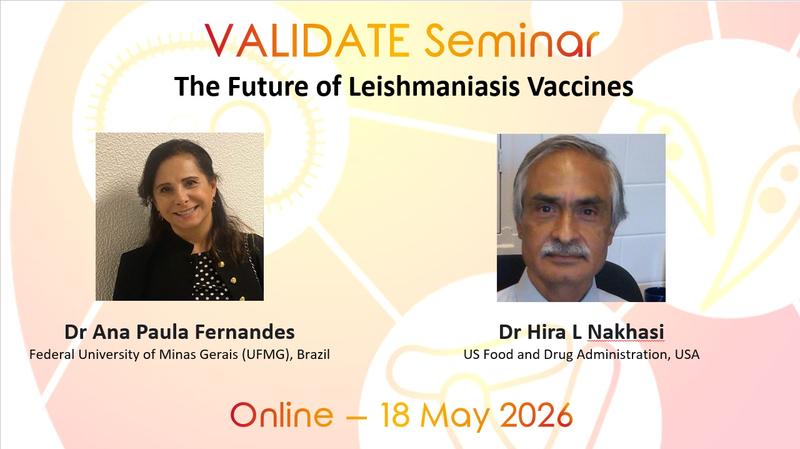
Watch this talk on the VALIDATE Hub.
This seminar explored two novel approaches to leishmaniasis vaccine development, highlighting recent advances and progress towards effective human vaccines. The talks were relevant across the VALIDATE Network, regardless of pathogen focus, and particularly to members interested in live attenuated vaccine strategies and the identification of biomarkers of protective immunity.
About the Talks
A New Recombinant Vaccine Formulation for Visceral Leishmaniasis
Dr Ana Paula Fernandes, Center for Technology in Vaccines (CTVacinas), Universidade Federal de Minas Gerais, Belo Horizonte, Brazil
Visceral leishmaniasis (VL) remains a major cause of morbidity and mortality worldwide. In the absence of prophylactic vaccines, control measures rely on controlling vectors and reservoirs, alongside effective diagnosis and treatment.
Dr Fernandes presented an end-to-end translational study spanning antigen discovery through to the development of VaxLeish, a vaccine formulation intended for evaluation as a therapeutic vaccine in a Phase I clinical trial. Antigen selection was based on epitopes from the well-characterised vaccine candidate A2 and sequences from a newly identified Leishmania infantum antigen, Kinetoplast-Associated Protein-like (LinKAP).
Like A2, LinKAP contains multiple tandemly repeated amino-acid units with highly conserved predicted epitopes across several Leishmania species. CRISPR-Cas9 deletion of the LinKAP gene did not impair parasite growth, differentiation or infectivity in macrophages, suggesting that it is not essential to these functions in vitro, although its precise role remains unknown.
A recombinant truncated version of LinKAP induced partial protection in immunised mice and hamsters and generated a robust Th1-type immune response. Based on these findings, mapped epitopes from A2 and LinKAP were combined into the chimeric antigen rKAPA2, produced under good laboratory practice conditions.
VaxLeish, comprising rKAPA2 and Poly ICLC, was extensively evaluated as a prophylactic vaccine in animal models. It was found to be highly immunogenic, partially protective and safe, while several quality attributes were defined in accordance with regulatory requirements.
The formulation was also evaluated as a treatment in L. infantum-infected mice and hamsters. Treated animals showed a shift towards a Th1 T-cell response, with increased frequencies of IFN-γ-producing T cells and fewer IL-10-producing T cells. This suggested a partial reversal of the immunosuppression caused by infection and correlated with a marked reduction in parasite burden, supporting the potential use of VaxLeish as both a prophylactic and therapeutic vaccine for VL.
Based on these findings, Dr Fernandes proposed that VaxLeish should advance towards clinical trials.
Recent Advances in Leishmania Vaccination Development and Identification of Biomarkers of Protective Immunity
Dr Hira L. Nakhasi, PhD, FASTMH, Division of Emerging and Transfusion Transmitted Diseases, Center for Biologics Evaluation and Research, US Food and Drug Administration, Silver Spring, Maryland, USA
Leishmaniasis is a neglected tropical disease caused by infection with Leishmania parasites transmitted through the bite of an infected sand fly. It produces a range of clinical presentations, from cutaneous leishmaniasis (CL), which can cause physical disfigurement, to visceral leishmaniasis (VL; kala-azar), which is fatal if left untreated.
Millions of people worldwide are at risk, with more than 200,000 cases of CL and 50,000 cases of VL estimated to occur each year. Although elimination programmes have reduced the burden of VL in South Asia, outbreaks have recently been reported elsewhere in Africa and South America, as well as in previously non-endemic areas.
Achieving the global elimination of leishmaniasis will require new tools, including improved surveillance and a safe and effective vaccine. Asymptomatic infection or successful treatment of VL generally confers lifelong immunity, while the stability of the Leishmania genome indicates that a live attenuated vaccine strategy may be feasible.
Dr Nakhasi’s laboratory developed a genetically modified, live attenuated dermotropic Leishmania vaccine—the Leishmania major centrin gene-deleted parasite (LmCen−/−)—which demonstrated safety and efficacy against both cutaneous and visceral leishmaniasis in preclinical studies.
Dr Nakhasi discussed progress in advancing the LmCen−/− vaccine towards human trials, efforts to identify biomarkers of immunity, and the use of the leishmanin skin test as a surrogate biomarker of protective cellular immunity.
About the Speakers

Ana Paula Fernandes holds a B.Sc. in Biological Sciences (1986), an M.Sc. in Microbiology (1990) and a Ph.D. in Parasitology from the Federal University of Minas Gerais (UFMG, 1997). She was a research fellow at Harvard Medical School (USA), during master and Ph.D training. She is currently a Researcher Level IA at the National Council for Scientific and Technological Development (CNPq) and a Full Professor at UFMG, where she supervises pos-graduations students in programs in Genetics, Biochemistry and Immunology and Pharmaceutical Sciences.
Her research lines encompass molecular biology, clinical diagnostics, parasitology and immunology, with emphasis on the diagnosis and treatment of infectious and genetic diseases, and vaccine development for infectious agents. She is one of founders of UFMG’s Vaccine Technology Center (now the National Vaccine Center) and has coordinated translational projects leading to licensed products, including the Leish-Tec vaccine for canine visceral leishmaniasis (registered with MAPA) and a rapid test for hepatitis delta (registered with ANVISA). So far, she published more than 180 articles and supervised over 60 master and Ph.D students and post-docs.
Her scientific and innovation contributions have been recognized by multiple honors, including the Peter Muranyi Health Prize (2014, 2023), the “Good Example in Science” award (FAPEMIG/FIEMG/IEL/Rede Globo), the U.S. Embassy “Outstanding Woman” recognition for contributions during the COVID 19 pandemic, the 2022 Inconfidência Medal of Honor, and the 2022 CONFAP Innovative Researcher award. She was also a finalist for the EURO Prize for Innovation in the Public Sector (2023).

Dr Hira L Nakhasi is currently the Director of the Division of Emerging and Transfusion Transmitted Diseases (DETTD) at the Center for Biologics Evaluation and Research (CBER) of the US Food and Drug Administration. As the Director of the DETTD, he is responsible for approving assays to screen blood donors for blood borne pathogens and retroviral diagnostic to ensure USA blood safety. He received his master’s and Ph.D. degrees in biochemistry from the M.S. University of Baroda, India and postdoctoral training at the National Institutes of Health, Bethesda, Maryland and Columbia University, New York, USA. His scientific expertise lies in molecular virology, parasitology, cell biology, immunology and vaccinology. His main research is focused on Leishmania pathogenesis and develop methods to evaluate safety and efficacy genetically modified Leishmania vaccines and diagnostic tools. He has published over 170 publications including reviews and book chapters, being a member of the review committees of several high impact journals, reviewer of grants, and being invited to speak at national and international forums. He is also a member of the several scientific organizations. Over the years he has received numerous awards including US Department of Human and Health Services Distinguished Service Award. He is elected Fellow of American Society of Tropical Medicine and Hygiene. He also has been recipient of several grants from International agencies such as Global Health Initiative and Technologies, Japan; Wellcome Trust UK and National Institutes of Health, USA worth over 10 million dollars for his studies on Leishmania vaccine development.

